Game
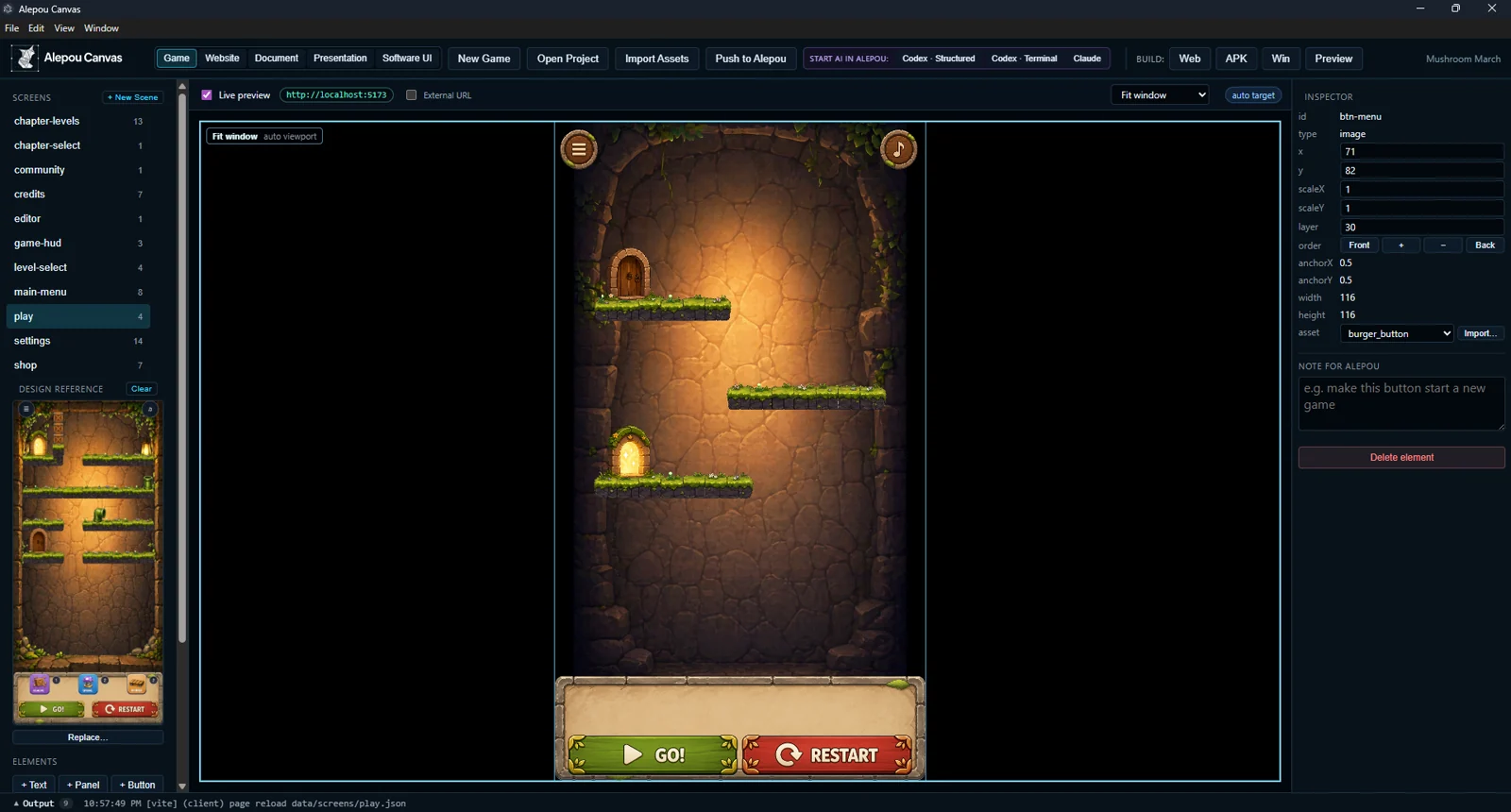
Screens, scenes, behaviours, reusable assets, and a code-backed gameplay escape hatch.

Active pre-release development · Free and open source
Create games, websites, presentations, documents, and software interfaces as structured visual projects—not flattened screenshots and not an endless loop of regenerated code.
Use Canvas inside Alepou as an optional first-party companion, or run it independently as a resilient visual editor.
One studio, five artifact types
Every Canvas project gets a real folder, validated structure, Alepou planning context, and room to grow. A CV does not need to pretend it will stay small—and a game does not need a different collaboration system.
Screens, scenes, behaviours, reusable assets, and a code-backed gameplay escape hatch.
Responsive pages and components with deterministic output and preview.
Editable slides, narrative order, visual directions, and export-ready layouts.
CVs, letters, reports, and fixed print-oriented pages without throwaway setup.
Software screens, flows, and component systems for products still taking shape.
Design with AI
Canvas separates two jobs that should never have shared one ambiguous button. A new deck needs narrative planning. An existing deck needs its structure respected.
Turn the brief into a bounded 3–24 slide plan. Review the proposed count and narrative outline, then compare two complete visual directions before compiling either one.
Keep the current page count and content structure fixed while the agent develops two genuinely different visual treatments around it.
High contrast · editorial rhythm · cyan signal
Warm field · softer geometry · measured pace
Hybrid compilation
Canvas measures the chosen specimen, proposes a separate editable artifact, and reports how each visual treatment will be represented before acceptance.
Text, images, geometry, position, sizing, typography, colour, and ordinary composition remain directly editable.
Complex visual treatments can become locked decoration layers so the result does not silently lose its character.
Interactive or unusually complex regions stay bounded components while Canvas owns their position and editable props.
Illustrative representation mix—not a claim about every project. Canvas reports the actual result for each compilation.
First-party Alepou companion
Alepou owns project registration, AI sessions, planning, memory, tasks, orchestration, and audit. Canvas owns visual structure, rendering, editing, previews, and artifact-specific context. They meet in the same project folder.
memory · tasks · docs
sessions · audit
pages · elements · assets
components · exports
snapshot · commands
results · captures
Built in Canvas
The portrait phone game was shaped in Canvas—mechanics, levels, interface, and visual direction—before becoming the source material for a separately implemented mixed-reality Quest experience through Unity Bridge.
Read the case studyAlepou Canvas
Canvas is free and open source under Apache 2.0. The current builds are pre-release and evolving quickly.